
One of the first things we noticed while working in logistics across MENA was something surprisingly simple:
Most companies talk about service levels.
Very few measure them.
You'll often hear promises like “next day delivery,” “fast inbound processing,” or “priority support.”
But when something goes wrong, there's rarely a clear system showing what happened, why it happened, or how often it happens.
For merchants and growing businesses, that lack of visibility creates real friction.
Inventory gets delayed, orders miss dispatch windows, support tickets sit unsolved longer than expected, and without data, it's difficult for anyone to improve the system.
That realisation pushed us to rethink how SLAs should work.
At Sirdab, we didn't just want SLAs written into contracts, we wanted them embedded directly into operations.
So, we built a framework that tracks them across the entire logistics journey.
Not monthly reports.
Not manual spreadsheets.
Seamless operational tracking.
Turning SLAs into something measureable
Instead of treating SLAs as abstract commitments, we broke them down into operational checkpoints across four core areas:
- Inbound processing
- Outbound Fulfillment
- Last-mile delivery
- Customer support
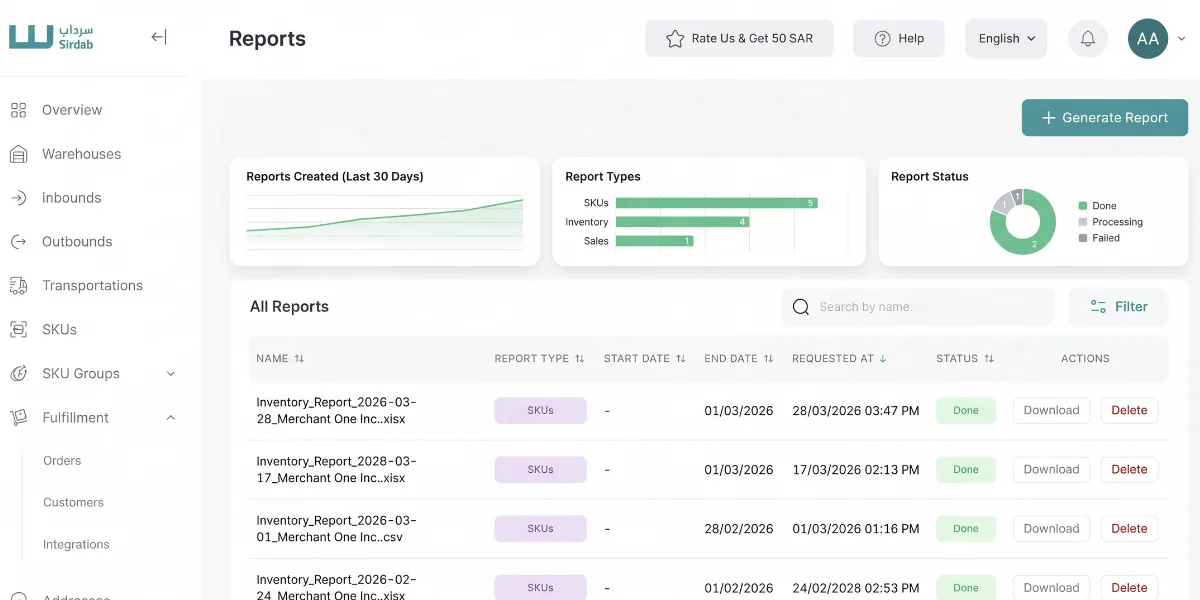
This also pushed us to evolve the Sirdab portal itself. Many of the features our clients use today were built after analyzing SLA data and support ticket trends.
Inbound operations: accurate inventory, faster
Inbound logistics is where everything starts.
If receiving, verification, and put-away processes slow down, the entire supply chain feels it.
Therefore, we began measuring inbound speed and accuracy closely.
- Daily manifest checks became standard across warehouses
- Inbound documentation and processing timelines are tracked continuously
Outbound: measuring orders, not promises
When an order is placed, expectations are clear: it should ship on time and arrive complete.
We track On-Time In-Full (OTIF) performance across every outbound order.
That means monitoring:
- When orders are picked
- When they are dispatched
- Whether delays occur
- The real reasons behind SLA misses
If an order falls outside SLA expectations, it is flagged immediately. In some cases, those trips are even held from calling until they're reviewed.
Accountability and transparency improve performance for everyone involved.
Last-mile delivery: where logistics meets the customer
Last-mile delivery is often where customers judge the entire experience.
We track delivery SLAs across routes, cities, and partners.
- Performance reviews happen weekly
- Routes can be reassigned based on reliability
- Operational exceptions, missed pickups, address issues, and delays are logged and resolved systematically
This helps us continuously improve how delivery volumes are distributed across our partner network.
Support: the unexpected driver of product innovation
One of the biggest surprises for us was how much customer support data improved our platform.
Every support ticket tells a story:
- Sometimes it's a delivery delay
- Sometimes it's a missing document
- Sometimes it's a simple question about inventory
By tracking support SLAs and analyzing ticket patterns, we realized that many of these issues could be solved through better product features.
That's how several improvements inside the Sirdab portal came to life:
- Ticket tracking directly inside the portal
- Clearer activity logs for operations
- Faster visibility into order and Inbound Statuses
- More transparency between clients and warehouse teams
- Clearer reports for merchants
- Simpler and faster warehouse visit requests and confirmations
Support wasn't just about solving problems; it became a feedback engine that helped us improve the platform itself.
What the numbers started to show
Once the system matured, the results became clear.
Today we see:
- 6,000+ pallet positions audited weekly
- 97% + Inbound Confirmation SLA
- 95% + dispatch SLA performance
- 99.5% + order accuracy
- 95% support SLA adherence
But beyond the numbers, the biggest change has been confidence.
Our clients now know exactly how their operations are performing, and where improvements are being made.
Why this matters
Logistics is built on trust.
Businesses trust that their inventory will be handled correctly.
That orders will move on time.
That if something goes wrong, it will be fixed quickly.
SLAs should be reinforce trust, not just exist on paper.
At Sirdab, we believe the only way to do that is by making performance visible, scalable, and continuously improving.
Because in logistics, the real difference isn't promising good service.
It's proving it every day.