What It Actually Takes to Clear a Stadium in Two Weeks
A fulfillment operator's view of the King Fahd International Stadium relocation, and what it says about where logistics in Saudi Arabia is heading.
When Saudi Arabia's iconic King Fahd International Stadium needed a full restoration, the clock was already ticking. Sirdab stepped in to relocate the entire VIP section cataloguing thousands of assets, activating three warehouses overnight, and coordinating on-demand transport, all within a two-week window.
I spent ten years at Amazon working across fulfillment operations, marketplace, and seller support. Over that time, I learned that the hardest logistics problems are rarely the ones that look complicated on paper. They are the ones where everything has to move at once, where you cannot plan ahead because the scope only becomes clear once execution is underway, and where a delay on your end triggers a cascade of delays for everyone downstream.
The King Fahd International Stadium project was exactly that kind of challenge, and watching Sirdab execute it gave me a clear view of what this company is genuinely capable of.
The Challenge: The Real Problem Wasn't the Volume. It Was the Unknowns.
When the Ministry of Sports commissioned the restoration of King Fahd International Stadium, the VIP section had to be fully cleared before construction could begin. Saudi Binladin Group, the appointed contractor, needed warehousing, inventory management, and transport fast.
On the surface, that sounds like a straightforward warehousing job. But three factors made it genuinely difficult:
- The inventory was a mix of high-value furniture, fixtures, equipment, and items earmarked for auction, each requiring different storage conditions.
- Nobody could estimate the total volume upfront. The scope would only become clear as the clearance progressed.
- The deadline was fixed. The stadium restoration had a start date, and the clearance had to be complete before it.
Any one of these factors is manageable. All three together, within a two-week window, require a different operational posture.
"The contractor had no clear estimate of how much space would be needed, and every single item had to be individually identified and tracked. All of this had to happen within two weeks."
Under Pressure: What Good Fulfillment Operations Actually Look Like
I have seen a lot of warehousing operations. The difference between a good one and a great one is almost never the size of the facility or the technology in use. It is the ability to absorb uncertainty without losing control of the process.
Here is what Sirdab delivered on this project, and why each element mattered:
Three warehouses, activated in 24 hours
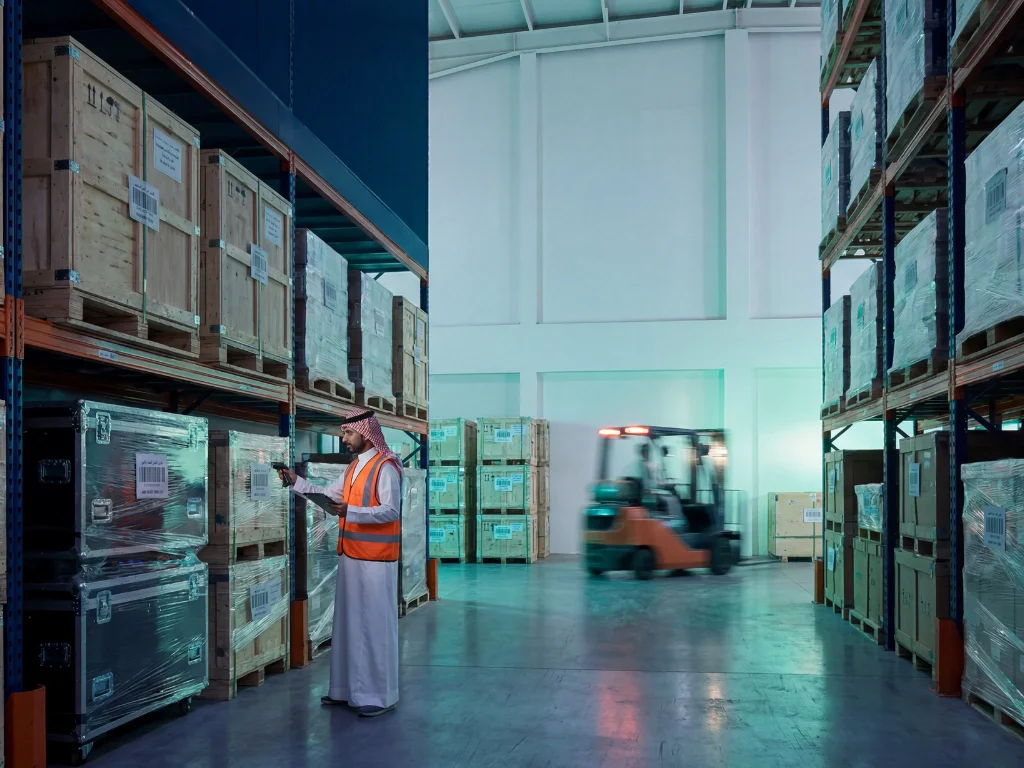
Dry storage for furniture and fixtures. Temperature-controlled space for sensitive items. A separate area for auction inventory. All three were ready within a day of the engagement beginning no site surveys, no multi-week onboarding, no waiting. This kind of network flexibility only exists when you have invested in building it before you need it.
Flexible capacity that scaled with the job
Because nobody could estimate the total volume upfront, the only viable approach was to design for expansion from day one. Sirdab's capacity scaled as the true scope of the relocation became clear. In operational terms, this is the difference between a warehouse that gives you what it has and a fulfillment partner that gives you what the job requires.
Full inventory visibility from day one
Every item was identified, counted, sorted, and logged into an online catalogue. The contractor could see exactly what was stored, where it was, and its status at any time. In a project with hundreds of stakeholders, a restoration schedule, and auction inventory in the mix, any ambiguity about what is where creates risk. Full catalogue visibility eliminated that risk entirely.
On-demand transport until the job was done
Rather than a fixed transport schedule, Sirdab coordinated multiple trips on demand as items were cleared from the stadium. This continued until every piece was accounted for, with zero disruption to the restoration timeline. Operationally, this is what asset accountability at scale looks like: not a report at the end, but continuous, visible movement throughout.
The Bigger Picture: Why This Matters Beyond One Stadium
Saudi Arabia is in the middle of one of the most ambitious infrastructure development programs in the world. Vision 2030 is generating a wave of construction, renovation, and venue-preparation projects across the Kingdom stadiums, arenas, hospitality developments, and government facilities. Every one of these projects creates a logistics challenge that runs parallel to the construction itself.
The assets have to go somewhere. They have to be tracked. They have to be available for reuse, auction, or disposal at the right time. And the entire operation has to happen without disrupting the project schedule.
Most traditional warehousing providers are not built for this. They are set up for predictable, recurring inflows, not for large-scale, time-critical relocations with an undefined scope. Sirdab is different because the platform was built around flexibility and visibility from the start.
"Behind every major construction and restoration project in Saudi Arabia is a logistics challenge that requires speed, precision, and full accountability over every asset. That is precisely what we are built for."
The Verdict: What I Look for in a Fulfillment Operation, and What I Found at Sirdab
Coming from Amazon, my benchmark for operational excellence is high. What I look for is simple: does the operation stay in control when the situation is not? Can it absorb unexpected changes in volume or scope without losing visibility? Does it deliver accountability at every step, not just at the end?
The King Fahd project demonstrated all three. Three warehouses were stood up overnight. Capacity flexed as the scope grew. Every item was catalogued and visible throughout. Transport ran on demand until the last asset was cleared.
That is not a marketing story. That is what fulfillment operations look like when they are genuinely built to perform under pressure.
Are you planning a large-scale construction, renovation, or infrastructure project in Saudi Arabia?
Sirdab can handle the logistics from warehousing and inventory management to on-demand transport and full asset visibility.