At Sirdab, efficiency isn’t just about what happens on the warehouse floor, it’s about how deeply we understand every part of our business, every day. From how inventory moves, to how deals close, to how our clients interact with us online, we’re constantly generating valuable data.
Being data-driven sounds good on paper, but in reality, data lives everywhere: operational databases, CRM tools, customer support chats, website and app analytics, marketing platforms, financial systems, and even physical documents.
Left scattered, this information is just noise. You can’t stitch it all together in a spreadsheet forever, especially when you need to answer questions like:
- What landing page or ad campaign drives the highest revenue per lead?
- Which product features really boost customer engagement and retention?
- Which clients are showing early signs of churn, or growth?
These aren’t abstract questions. They drive real decisions: how we price, who we reach out to, when we invest in new capacity, and how we help clients grow. That’s why we invested in building a modern, AI-assisted data stack, a single source of truth that makes our data clean, connected, and queryable at any time.
🧩 How it works
Here’s what this looks like in practice:
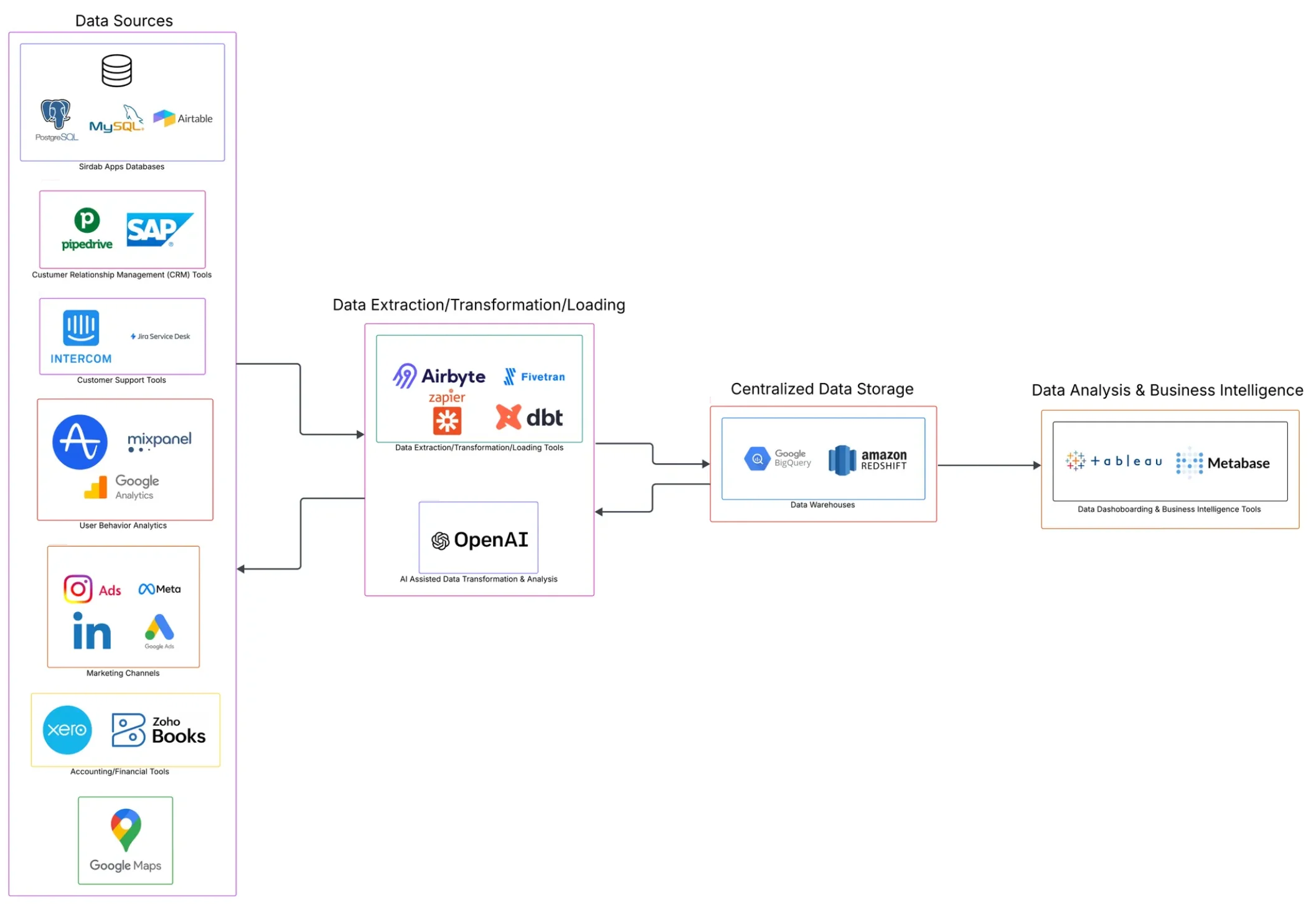
✅ Collect:
We automatically pull raw data from dozens of sources:
- Operational data: PostgreSQL, MySQL, and Airtable, where we track everything from inventory to orders and warehouse locations.
- CRM & sales: Pipedrive, SAP, so we know what deals are in the pipeline and how accounts move through the funnel.
- Customer support: Intercom, Jira Service Desk, every ticket, chat, or service SLA is tracked.
- User behavior: Mixpanel, Google Analytics, we see how users interact with our merchant portal, partner portal, or landing pages.
- Marketing channels: Google Ads, Meta Ads, LinkedIn Ads, TikTok Ads, to see how ad spend ties back to real conversions.
- Financials: Xero, Zoho Books, revenue, invoicing, and cash flow.
- Geospatial data: Google Maps, which we use for transportation and route optimization.
- All this gets synced continuously through modern connectors like Airbyte, Fivetran, and APIs, so our teams never work with stale data.
🔄 Transform & combine:
Data from different systems is messy and doesn’t speak the same language.
We run robust ETL/ELT pipelines using tools like dbt to clean, standardize, and join everything into a unified model.
We also tap into AI where it makes sense, for example, to process unstructured documents from partners or clients and turn them into usable data instantly.
The goal: make sure that when we say “customer revenue” or “inventory units,” we mean the same thing across every report.
🏢 Store centrally:
All that clean data lives in our cloud data warehouses, Google BigQuery and Amazon Redshift, designed to handle millions of rows and real-time updates.
We version our models and control access, so teams have what they need without compromising governance or security.
The result is a single, up-to-date source of truth that anyone can query with SQL or explore visually.
📊 Analyze & act:
This is where it all pays off. Teams across sales, operations, finance, and marketing use BI tools like Metabase and Tableau to build dashboards, track KPIs, and get alerts when something unusual happens.
Analysts can run complex queries in seconds. Our forecasting models flag trends early, like a client’s inventory dipping faster than expected, so we can act before it’s a problem.
🪜 Built to scale:
Best of all, this stack is modular and cloud-native. We can add new data sources, plug in better tools, or expand our AI capabilities without tearing the whole thing down.
It’s built to grow as our business grows, whether that’s more clients, more partners, or more complex logistics.
🔍 What this unlocks for us
Having this foundation is about far more than dashboards. It enables real, everyday applications like:
🚀 Revenue & growth insights
- Identify which landing pages, campaigns, or app flows drive the most revenue.
- Measure how new features impact usage and retention.
- Predict which leads are likely to close, and prioritize accordingly.
📦 Operational forecasting & inventory
- Forecast when a client’s inventory will run low, and send proactive alerts.
- Spot trends in storage or transportation usage to plan capacity and dynamic pricing.
- Predict monthly revenue with a clear view of seasonality and operational shifts.
🤝 Customer relationship & retention
- Build rich client profiles by combining user behavior, support tickets, orders, and financial trends.
- Get alerts when revenue or usage dips, so our team can reach out.
- Analyze support chats with AI to monitor sentiment and find areas to improve.
- Track SLAs for customer support, order processing, and transportation journeys.
📈 Marketing performance
- Tie ad spend across Google, Meta, LinkedIn, and other channels directly to qualified leads, deals closed, and actual revenue.
- Optimize campaigns based on what works, not just clicks.
🗂️ Smart automation & AI-powered processes
- Use AI to read and standardize documents, from invoices to contracts, and feed them straight into our systems.
- Free up teams from repetitive manual data entry.
🔮 What’s next
We see our data stack as an engine for our growth, not just a reporting tool. It gives us faster answers, smarter predictions, and a clearer path to serving our clients better.
And it’s never finished, we’re always adding new tools, new automations, and new ways to turn raw information into real action.
If you’re building something similar, or exploring how to connect all the pieces, we'd love to swap ideas. Let’s make our companies smarter, together.



 (1).webp)